Tempting dark power

{mosimage}Stan Lee (who makes a cameo again in this third part) and Steve Ditko created in 1962 a new superhero that after the past of decades has been even able to steal the love of many fans from other untouchable legendary characters like Batman or Superman. The name was Spider-man, and Sam Raimi took the responsibility to take his adventures into big screen.

{sidebar id=40}They usually say that third parts were never good, but Spider-Man 3 is a clear exception to the rule. Not only the best film of the trilogy, but in my opinion, the best comic adaptation from the last years. Raimi has caught all the spirit of the comic, the charming of a Peter Parker that can be very strong after his fragile appearance. But obviously one of the features that make Spider-Man 3 stand out is the new and visually shocking enemies: the raw power of Sandman (Thomas Haden Church) and overall the most awaited and probably beloved evil guy of the whole Marvel comics sagas: Venom. Tobey Maguire shows once more that he is perfect for the role; when Peter Parker behaves good, people like him, but when he is bad you just have to love him. Kirsten Dunst as the red-haired Mary Jane exhales sensuality every time she talks or sings, and the new incorporation of Topher Grace adds a new fresh value to a film full of dualities, from Spider-Man himself and all the characters surrounding him, where not everything is just black and white and there is not absolutely evil or innocent behaviour; a great example to take with us for the real everyday life.

If you have the chance, pursue the Special Edition with a very interesting 2-disc format, a great design on the cover and some good extras, being specially interesting the one that explains the creation proccess of the character of Venom. If you like comics, cinema and action that will make you be literally stitched to your seat for a bit more than 2 hours, do not miss Spider-Man 3. 

Participate in our competition and get the official Spider-Man 3 trolley bag. Click here

Turku officially European Capital of Culture 2011

Finnish Minister of Culture Stefan Wallin finds the decision a great honour for the City of Turku, for Finland and for Europe. “Turku is Finland’s oldest city, and a place from which culture originated and remains to this day. This is a great day for us all. It feels wonderful to be from Finland and, even more specifically, from Turku”, Wallin commented in Brussels.

Every year cities in two EU countries get the honour to carry the title of European Capital of Culture for one year, based on a system of rotation. This year’s European Capitals are the cities of Luxembourg and Sibiu (Romania).

Cultural capitals have been chosen since 1980. The cities are given the chance to showcase their cultural diversity and development and promote their cultural activities internationally.

The cities of Turku and Tallinn are planning close co-operation.

Celebration
On Tuesday (20.11) the City of Turku is organizing a big Turku On Fire celebration on the Aura River banks to thank the thousands of people who took part in the bidding process. From 6 p.m. there will be a big fire show with dozens of performers at the Theatre Bridge next to the Turku City Theatre.

The organizers are kindly asking the audience to gather on the western side of the river close to Pharmacy Museum and the Student Theatre.

Turku 2011

Tallinn 2011

Bringing theatre people together

{mosimage}Theatre lovers do not often have many opportunities to enjoy good plays in other languages than Finnish. The 4th International Baltic Circle Theatre Festival will bring temporarily a solution to the problem.

Finnish and foreign audiences have an excellent opportunity to discover artists from different places in Europe in the International Baltic Circle Theatre Festival, since one of the goals of the festival is to build a bridge for theatre lovers, companies and actors all over Europe.

 The quality of the plays featured this year is really high. Latvian director Alvis Hermanis, who won the European Theatre Prize this year, will show his play Ice, an extraordinary tale focused on a sect that hunts for “living hearts”, a stage adaptation of the Russian author Vladimir Sorokin. Meanwhile, Belarusian group Free Theatre, that is also a European Theatre Prize winner, will perform three plays, one being a world premiere. The three performances are subtitled in English. Lithuania is also represented in the festival with the Theatre Laboratory Atviras Ratas, visiting with its play Open Circle, aimed at being an open forum for the young actors.

Not only Baltic groups come to the festival, but also many others with a great presence of Scandinavian ones. The Swedish Teater Terrier will perform its brand new performance Dallas, and the Norwegian Verk Produksjoner will bring on stage a work from the most famous Norwegian dramatist, Finn Iunker. All these plays are in English.

The Slovenian director Janez Janša will bring some polemic to the festival with his interactive movie DemoKino, dealing with topics like abortion, cloning, etc. The audience can vote in favour or against each topic and decide how the movie continues. This is a totally innovative concept, a “choose your own adventure” book idea  turned into a film.

Apart from plays, the festival offers much more for those interested in the world of theatre. Jeff Johnson, an American theater scholar, will give an international theatre seminar where the present situation of theatre in Baltic countries and Finland will be discussed.

Performances

Ice
Jaunais
Rīgas Teātris (Latvia)
Directed by European Theatre Prize
winner Alvis Hermanis.

18-19.11 – 7 pm

Being Harold
Pinter

Free theater (Belarus)

The play is based on the text of Nobel prized author Harold
Pinter. The plot lines are held together by one central theme: the
problem of violence in its many diverse forms.

18.11 – 5 pm

Legends of
Childhood

Free Theater (Belarus)

The play is based on the personal stories of the
actors.
16.11 – 8 pm, world premiere


Generation
Jeans

Free Theater (Belarus)

A monologue about jeans, rock music and freedom.

17.11 – 7 pm

Ifigeneia
Verk Produksjoner (Norway)
Norwegian
dramatist Finn Lunker ponders the reasons for war in his adaptation
of Euripides’ classic.

17.11 – 7 pm
18.11
– 3 pm


Solesombra

Teatr
Akhe & Theatre Satire on Vasilyevsky Island (Russia)
A tender
and bitter story about the universal loneliness, the ideal of
happiness – and the impossibility of it.

21.11 – 7 pm


Open Circle

Atviras
Ratas (Lithuania)
The goal of the Open Circle’s young
Lithuanian actors is to talk straight theatre language abiding by the
rules of theatre.
21.11 – 7 pm
22.11 – 4 pm

Best of Dallas
Teater Terrier
(Sweden)
The greatest cliffhanger in television history will be
solved: Who Shot J.R.?

23-24.11 7 pm

I Do Not Speak of
Love Here

Teatr Cinema (Poland)
A visually formal and physical
study of loneliness.

16.11 – 6 pm

17.11 – 5 pm

Films

Demokino
Aksioma
/ Janez Janša (Slovenia)
DemoKino makes the audience interact giving answers to the questions of life.

21-23.11 – 7
pm
24.11 – 3 pm

Kinoteatr.doc (Russia)
Kinoteatr.doc presents five movies from its repertoire.

21-22.11 – 7 pm

Baltic Circle 2007: 16-24.11 IN HELSINKI
For more information and full schedule with the list of venues: 
www.Q-teatteri.fi/baltic_circle

www.q-teatteri.fi/baltic_circle/eng/index.html

Shortlist for this year’s Finlandia Prize announced

Nominated for the Finlandia prize 2007 are:

Kohti [‘Towards’] by Juha Itkonen

Det har varit kallt i Madrid [‘It’s been cold in Madrid’] by Agneta Ara

Romeo ja Julia
[‘Romeo and Juliet‘] by Jari Järvelä

Lakanasiivet [‘(The) Bed sheet wings’] by Sirpa Kähkönen

Sakset [‘(The) Scissors’] by Laura Lindstedt

Toiset Kengät [‘The other shoes’] by Hannu Väisänen

Literature researcher Laura Lindstedt is the debutant on the short list. Hannu Väisänen is a well-known Finnish artist. Swedish-speaking Agneta Ara is a Finnish novelist and poet who earlier won the Runeberg Prize for literature. Sirpa Kähkönen is a novelist and translator who has written both books for children and young adults and historical novels.

Well-known Finnish writers Jari Järvela and Juha Itkonen have both been nominated for the Finlandia Prize before. Itkonen is also on the short list for the 2007 Finlandia Junior award (literature for children and young adults) for his book
Taikuri Into Kiemura.

The 3-person selection committee read a total of 94 works. The final receiver of the Finlandia Prize for fiction is this year chosen by cultural editor Kaisu Mikkola. The winner, who will also get a 26,000-euro award sum, will be announced on the 4th of  December.


Related:
Nominations for Finlandia Junior award announced

Finlandia Prize – Wikipedia

Danish dancer next Artistic Director at National Ballet

The Board of Directors of the Finnish National Opera Foundation decided on the appointment on Wednesday (14.11), after it had proposed him for the job two weeks earlier. Also the personnel groups of the Finnish National Opera agreed unanimously with the nomination.

As Artistic Director, Greve will be responsible for the artistic planning and development of the classical ballet and modern dance programme of the FNB. He will also be in charge of the content and artistic policy of the Ballet.

The term of the current Artistic Director, Dinna Bjørn, ends at the end of July, 2008.

Related:
Danish dancer nominated for director post at National Ballet


Kenneth Greve in Etudes (Royal Danish Ballet)
– DR1/YouTube

Interview with Kenneth Greve – Ballet-Dance Magazine (May, 2006)

Finnish National Ballet (at the Finnish National Opera)
Press release about the nomination of Greve – Finnish National Opera (31.10.2007)

Danish Royal Ballet

Moving pictures experience


Every year, when it’s dark and cold,
the Avanto festival presents the most innovative tendencies in music
and visual arts. This year’s edition focus on films under the title
of International Free Cinema. The festival is held this weekend in
several venues around Helsinki.

{mosimage}

Like dancing to the rhythm of
free jazz, the moving pictures shown at the Avanto festival question
traditional ways of making and watching films. The festival has
invited two pioneers of experimental filmmaking: the Canadian artist
Michael Snow and the Austrian artist Peter Kubelka. Both will be in
Helsinki and present a retrospective of their essential works.

Last
year the festival paid tribute to the local experimental filmmaking.
This year’s programme turns to the neighboring countries and brings
some rarities of Swedish and Russian experimental cinema. Curated by
researcher John Sundholm, the series Närä ögat
features a wide selection of Swedish experimental films from the
1950s and 1960s. On the other hand, the series Stekliannoe pole shows
the most vanguardist filmmaking currently done in Russia, in a
programme curated by filmmaker Masha Godovannaya.

Avanto has
also room for more widely known films. The festival offers a unique
opportunity in Finland to watch Zidane: A 21st Century Portrait, a
visual tour-de-force about the French football star, directed by
Douglas Gordon and Philippe Parreno.

The festival also
premieres Esko Lönnberg’s documentary Saturnus Reality, a film that portraits the Finnish band Circle, and the recording
sessions of the album Miljard, where the group has coined the new
genre of NWOFHM (The New Wave of Finnish Heavy Metal) that can mean
“mean fragile atonal piano improvisation or catatonic one-note
walls of sound”.

The music side of the festival is
offered in co-operation with the Äänen Lumo and the
Potlatch clubs. The first was founded in 1995 to promote
electroacoustic and experimental music and sound art in Finland.
Within this framework, Avanto will feature the comeback gig of the
synthesiser pop band Organ, one of the pioneers of Finnish electronic
music, and from Japan, the noise band Pain Jerk. The atmospheric
bonfire organ music of the Swedish trio Tape will counterbalance the
noise experience.

The Potlatch club brings two British
and two Finnish acts to the stage that base their music on
improvisation to achieve different goals. Eddie Prévost and
Alan Wilkinson take free jazz as the starting point of their journey
while Volcano the Bear take their arsenal of instruments to create
“ritual out of absurd humour and free association”. Collective
Avarus and female band Kuupuu represent the new Finnish underground.

The Potlatch club will bring two British and two Finnish acts to
the stage. The four acts all base their music on improvisation, but
the results are wildly divergent. Eddie Prévost and
Alan Wilkinson take free jazz as the starting point for a
journey into the core of heat. With their arsenal of instruments,
Volcano the Bear creates a ritual out of absurd humour and
free association. The Finnish collective Avarus confounds the
audience with its concoction of spontaneous and energetic
improvisation, while Kuupuu investigates rich textures of tone
and timbre, representing the female power of the new Finnish
underground.


Avanto Festival

16-18.11.2007
Full programme:
www.avantofestival.com

The punk that died as a hippie

{mosimage}Five years ago, Joe Strummer, the leader of The Clash, died unexpectedly aged 50, victim of an undiagnosed congenital heart disease. He descended to the hell of punk after the break-up of The Clash, but a few years before his death, Strummer had revamped his musical career embracing global sounds with his backing band The Mescaleros. The recently released documentary Joe Strummer: The Future is Unwritten accounts this fascinating journey.

In a bit less than two hours, the documentary narrates Strummer’s traveling childhood (after his father, a British foreign-service, was located in places such as Cairo, Mexico City and Bonn), his teenage years (marked by the suicide of his brother), his stardom with The Clash, the turbulent post-Clash years and his comeback to music with The Mescaleros. Starting with impressive footage of the singer laying the vocals of the classic White Riot, director (and old friend) Julien Temple portraits the life of Joe Strummer through archival footage and personal interviews. Temple planned those interviews around a campfire (one of Strummer’s favorites activities). Former Clash members (like Mick Jones and Topper Headon), close friends and celebrities such as Johnny Depp, John Cusack, Steve Buscemi and Bono share memories and celebrate the life of Joe Strummer.

The editing is innovative and makes the storytelling quick. All the material comes together thanks to the voice of Joe Strummer himself that appears to underline the facts or just to set the mood of the journey spinning some records and introducing songs on the BBC World Service’s radio show London Calling.
Obviously much is told about The Clash. The story of the band becomes the centerpiece of the film: the origins, the success, the fame, the break up. Those were years of youth for Strummer. Wild and outspoken, but at the same time avoiding confrontation while his band mates were fired in the latter days of the group.

{sidebar id=39}In 1986, after the failure of the album Cut the Crap, the singer disbanded The Clash. There Strummer started long rambling years of different projects of mild success, soundtracks, a tour with The Pogues, legal disputes with Sony Records and even appearances in several films, including Aki Kaurismäki’s I Hired a Contract Killer (1990) and Jim Jarmusch’s Mystery Train (1989).

Those were difficult years for Strummer, but they are also the time when one would have wanted Temple to spend more footage of his documentary. It’s the “lost decade”. The images of Joe, alone in the studio, trying to find the right vocals and trying to find himself are some of the most valuable in the two-hour film.

But like happy end of a movie, Joe Strummer found content and peace of mind. He did it in an expected manner, in campfires around hippies. The punk made peace with his enemies. New sounds, a world folk, seemed to revitalize the singer, who put together a new band of young and talented multi-instrumentalist. The Mescaleros recorded three albums in three years and took successfully Strummer back to the road.

Even a reunion of The Clash seemed possible when Mick Jones joined Strummer on stage and the Mescaleros played a benefit concert for striking fire fighters. It was the first time both played together since 1983.

However that was also the last time. Just one month later, three days before Christmas Joe Strummer passed away. The world lost its hippiest punk.

The Future is Unwritten is a moving testimony of genuine rocker that remained true to himself, true to the idea that music has the power to change the world. It’s just too bad the film is only two hours long.

Tell me why I DO like Mondays

Time ago, when I was working or
studying, Monday was (like i suppose for most of the people in the same
situation) the most hated day of the week.

Saturday was great and relaxed; on
Sunday I started to feel a particular stomach ache while assimilating the
connection again with the harsh reality and to feel the anxiety that the good
free time was over…and on Monday morning the same resignation to face a long
and monotonous week, until Thursday (…I am in Love), when the light at the end
of the tunnel was visible again.

But now, being unemployed in
Finland, I am looking forward Mondays with the same anxiety with which not a
long time ago I was waiting for Fridays. Monday is a great day: new job offers
in the recruiting websites, people answering emails and phonecalls at their
office, a new hope that the luck will be with me this time. And when Friday
comes…oh my god!, Finnish start not to answer emails, to leave early from their
jobs with their minds full of week end plans at the cottage or at the nearest
pub and my last hope of getting a job interview, a couple of lines that could make me feel like a worthy human being again, and not like a person whose profile is not suitable for the required position, fades away.

3 days of agony and desperation
until Monday comes and the cycle starts again. So I can only wait and pray to
get a job soon for starting to hate Mondays (like any other civilized human
being) again.

Noheva – Pikatie

{mosimage}Debut album by the band from Oulu leaded by Jarkko Somero.

Coming from northern Oulu, Noheva lets the coldness aside and introduce us a more than recommendable warm debut album. With Jarkko Somero in the vocals, Jarno Nyman in the guitar, Mika Heiskanen as bassist and Arto Ek as drummer, Pikatie offers a good dosis of rock and roll and good stories in Finnish languages for those eager to listen to honest music. As the good wines that must be tasted step by step. The beginning of the album is quite calm with Panttilainaamossa, but when advancing in the tracklist, the guitar riffs acquire a bigger dimension and Somero starts to unveil some good vocal skills in front of the micro in songs like Kaipaan Sua, the catchy Miksen mä mee or the track that puts an excellent end to the album, the homonymous  Pikatie.

Songwriting, as it is traditional with the Finnish bands, is of an excellent quality. Songs about problems and feelings that soon or later we all have passed through. The melancholic Finnish spirit mixed with a warm feeling, with some compositions that could transport you into past summer days and old missed friendships; Pikatie reminds us that there is always a path to follow and the one Noheva has chosen is the correct one. Great work from the Oululaiset!

Rating 4/5

Shamrain – Goodbye to All That

{mosimage}Third album for the Finnish Shamrain. Quite an unknown band that deserves better luck due to the high quality of their compositions.

Apart from heavy metal bands, the Finnish market has received a flood of bands trying to imitate with better or worse luck the brit-pop mainsteam groups, especially because of the action of one of the most popular independent music brands in the country.  In the overwhelmed market of pop-rock Finnish bands singing in English, it is a fresh and unusual experience  to find a band like Shamrain.

Maybe it is because of that “melancholic touch” that all good Finnish band must have to succeed, maybe the inspiration of the lyrics written mostly by bassist Matti Reinola and guitarist Kalle Pyyhtinen, or just due to the transparent voice of Mika Tauriainen (who is also the lead singer in Entwine, where he can explode harder registers). Clear influences from bands like Placebo or Radiohead, a very high level composition and songwriting in tracks like Shallow Delusion or Evangeline, with a Tauriainen that just for some seconds can remind you of Ville Valo like during the first part of  Stars Will Fall.

We wish the best of lucks to Shamrain and hope that their new collaboration with Spikefarm Records will materialize in the success that this Goodbye to All That deserves.

Rating 4/5

Värttinä – 25

{mosimage}25 years as a band deserves a celebration. Värttinä was created in 1983, and now SonyBMG thought that there could be no better moment to offer a compilation to the fans.

Obviously, after 25 years, Värttinä does not need to show anything new to the public. The ones who like the bands peculiar style, rooted in Finnish folk traditions, know perfectly what to expect.  The album is offered in digipack version, and acquires the status of a big celebration. 22 tracks extracted from their 11 albums and an unreleased song as an extra: Vipinäveet. 24 page-booklet with pictures of all the band’s career and a tour of their evolution, from those pre-teen female voices of the beginning to the more mature ones of Susan Aho, Mari Kaasinen and Johanna Virtanen, the remaining and present singers.  Good time to take advantage of the opportunity that the album represents, since you must know that 25 has only been released so far in Finland, so if you don’t live in this Nordic country, do not expect to find it in the music shops.

At the same time of the appearance of this compilation, Värttinä is offering several shows in central Europe, around Germany and Switzerland, and it was recently announced as well the departure of their drummer “Jaska”  Lukkarinen.

Värttinä will not leave you indifferent. If you want to discover something unique in Finnish music scene, a band that adds to their vocal harmonies old Finnish poems (runo poetry) and takes influence from the Finno-Ugric tribes tradition, this is your album. But if you prefer other kind of music and get annoyed by the constant repetitiveness in the lyrics, maybe this album is not for you. Mostly recommended for those who want to explore one step farther on Finnish music than only HIM, The Rasmus or Lordi.

Rating: 3/5

When disability turns into virtuosity – Interview with Kaisa Leka

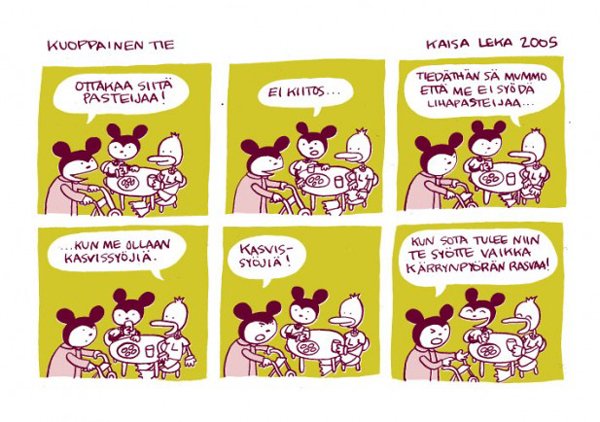
Editor of a yoga publication, graphic designer, cook, politician, teacher, traveler, comic artist… Kaisa
Leka
has not had an easy life. She had to take the terrible decision of getting her legs amputated due to an illness. But she has learnt and taught how to see the positive side of life and make the most of it!

Who is Kaisa Leka?

I’m a 29-year old artist, designer, teacher, and politician… a typical freelancer. I live in Porvoo in an old wooden house with my husband and our ridiculously large collection of toys, books and old typewriters.

How did you start to draw comics?

I drew comics as a child, and started again when I was 19. I fell immediately in love with how easy it is to both read and draw comics; it’s a really easily approachable art form. This enables me to deal with difficult issues such as disability and reach readers who wouldn’t otherwise pick up a book about it.

Kaisa Leka

What is different in Kaisa Leka´s comic strips from other authors? Most of the times, there are some characters that appear repeated while having dialogues. Can you explain a bit more about them?

A friend of mine said that my comics are like TV’s sitcoms, and I think it’s a pretty good way of describing them. No fancy drawings, exciting car chases or pretty girls with big breasts, just simple drawings and thoughtful texts. Or at least I hope they’re thoughtful!

I suppose the amputation of your legs it is something quite dramatic and a turning point in your life. Do you want to discuss openly about it? Is your wok I
am not these feet
directly aimed at that experience?

I was born with a disability that first seemed to only be a cosmetic one, but turned out seriously restricts my ability to move. I decided to have my feet amputated, with the consent of my doctors. With I am not these feet I wanted to let healthy people take a peek into the life of
disability, and also share my experiences with others who have had to spend time at a hospital. A lot of people have appreciated the way I’m breaking the tradition of silence and shame surrounding
disability and sickness.

You are active in other roles, such as politician. What things need to be improved in Finland for us, the young generations? Is Finland a country that pays a lot of attention to culture?

We have a great system of social security in Finland, but it’s built for people who have traditional 8 to 4 jobs, not for freelancers. Our generation isn’t going to have those jobs, and the system has to be adjusted to our needs. When it comes to culture, I think that the focus needs to be shifted from the masters of the 19th century to today’s artists. Culture is still often seen as something that can be supported if there’s some money left over from the "real investments", and if there is money it’s spent on projects celebrating the works of people like Sibelius
or
Runeberg.
Kaisa Leka

I can see that you are also very interesting in cooking and yoga.Tell us a bit more about those hobbies, and the works you havepublished about it.

I used to be the world’s lousiest cook, considering macaroni and ketchup to be a full meal. But then I met my
husband, whose food is the best I’ve ever had. Cooking has become more than just filling the belly, it’s a way of spending time with my husband and our friends, and experiencing new tastes. As a part of my
campaign for the parliamentary election this year I was able to publish a cookbook with two other Green candidates, and share some of our recipes with the Finnish public. A larger cookbook containing
more of them is one of my long-term plans.

Last year I did a book on bhakti yoga, the yoga of devotion, with a friend. As you might imagine it hasn’t been a huge financial success, but as I publish my books myself I can also publish stuff that’s not
aimed at the mainstream audience. We had a lot of fun doing the book, and have gotten some enthusiastic feedback for it from other practitioners of bhakti yoga.

You also publish a magazine, Ananda, with other friends. How is that project going?

Doing a magazine means a lot of late nights by the computer and long days working for others to finance the magazine. But it seems we’re doing something right since we were just named the Quality Magazine of the Year! A lot of people are interested in yoga now, and we want to offer a deeper look into it, as it’s so much more than just plain stretching. Through our own magazine we can let people who usually are invisible in the mainstream media get their voice heard.

Now other young female comic author, Milla Paloniemi, is getting quite popular in Finland. What do you think about her work?

I’ve only read a few of her strips but, to be honest, it’s not one of my favorite comics. But of course I’m glad
that a comic by a young female author is getting so much attention and making it easier for others to get their work published. I’ve held a lot of comics’ workshops for children and students, and I’ve been happy to see so many young girls doing their own zines and taking over this art form previously reserved only for men.

Kaisa Leka

One of your passions is traveling. You did a comic stripe saga about traveling for us in the past. In how many different countries have you been, and what are your favorite ones after visiting?

I’ve traveled quite a lot in Europe, and also visited USA and India. Traveling is my big weakness, even though I know it’s really un-ecological to fly around the world all the time! I do offset my carbon emissions through www.climatefriendly.com and try to minimize my emissions in my everyday life by using public
transport and saving electricity.

My favorite places are Philo in Northern California and Vrindavan in Uttar Pradesh, India. They’re places that I’ve visited with my spiritual teacher and dear friends, and homes to many Hindu temples and monasteries.

The good thing about being a freelancer is that I can work like a madwoman for a few months and then take some time off to travel. I guess I could say that my secret to finding enough time
for everything is avoiding housework at all costs.

I have seen that some of your works can be found in French, but is it possible to find English versions (apart from the stripes you did for FREE! Magazine)?

I’ve published several comic books in English, the newest ones are On the Outside Looking in (2006, 160 pages) and Little Fish Big Fish (2007, 30 pages). I’m also planning to publish a collection of comics that have been featured in different Finnish magazines, but I’m waiting until I can put together a really big book with them. It’ll probably be in English, or at least have subtitles.

What are your future projects?

I’m currently working on a new big book about a friend who gave up his graphic design studies, left his hardcore band and became a Hindu monastic. I’m really fascinated about the way he completely changed his life. I’m also going to publish a series of short stories based on Indian mythology; Little
Fish Big Fish
is the first one of them. And I just bought eight new sketchbooks (I was afraid they’d stop selling them so I decided to get a big stash) for my sketchbook blog,
so I guess I’ll also keep doing that for quite a while!


www.kaisaleka.blogspot.com


www.kaisaleka.net

Nominations for Finlandia Junior award announced

Nominated for the 2007 Finlandia Junior prize are:

> Tatun ja Patun Suomi (‘Tatu and Patu’s Finland‘) by Aino Havukainen & Sami Toivonen

> Taikuri Into Kiemura by Jukka Itkonen

> Filmi poikki (‘Film broken‘) by Hanna Marjut Marttila

> Herttuan hovissa – Elämää 1550-luvun Turussa (‘In the Duke’s Court – Life in the Turku of the 1550s‘) by Paula Moilanen & Kirsi Haapamäki

> Emilian päiväkirja – Supermarsu lentää Intiaan (‘Emily’s diary – Super Guinea Pig flies to India‘) by Paula Noronen

> Orava ja pääskynen (‘The squirrel and the swallow‘) by Maria Vuorio

The receiver of the prize, which comes with an award sum of 26,000 euros, will this year be chosen by Inkeri Näätsaari, the Director of the Turku City Library. The winner will be announced on November the 29th.

The Finlandia Junior award is one of three prestigious prizes awarded annually by the Finnish Book Foundation, the others being the Finlandia Award (Best novel, since 1984) and the Tieto-Finlandia (Best non-fiction book, since 1989).

The first ever book to win the Finlandia Junior was Gondwanan lapset (‘Children of Gondwana‘) by Iranian-born Finnish writer, documentary maker, director-producer and publisher Alexis Kouros, in 1997. Last year, the prize was awarded to Timo Parvela for his book Keinulauta (‘The seesaw‘).


Finlandia Prize
– Wikipedia